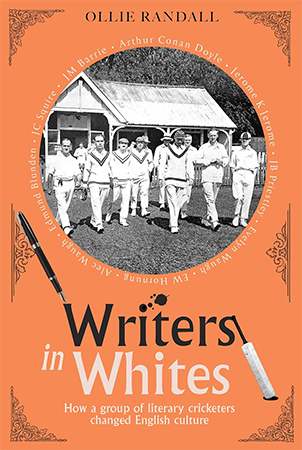
According to Ollie Randall, it is a nonfiction book about a coterie of writers who played cricket together for three generations, from JM Barrie, Arthur Conan Doyle and PG Wodehouse, via Evelyn Waugh and Edmund Blunden, all the way through to Henry Blofeld and Michael Morpurgo, and how their cricket-based friendships influenced their careers and the wider literary landscape.
Based on a wealth of new research, Writers in Whites tells the story of this group, from Jerome K Jerome via Evelyn Waugh to Michael Morpurgo. In doing so, it reveals cricket's influential - and sometimes controversial - role in London's literary world, from the 1880s to the 1960s.
The chapter The Good Old Days tells the story literary cricket in the early 1920s, demonstrating what a joyful and life-enhancing experience it could be for its participants. The regular players loved it; it mattered a great deal to them. There was also far more literary cricket in the 1920s than ever before. it was a big part of many writers' social lives. This is especially true in the cases of Clifford Bax and Alec Waugh, who wrote detailed descriptions of interwar literary cricket in no fewer than seven volumes of memoirs between them.
West Indian Learie Constantine, MBE, found fame for the passion and joy that he brought to his cricket. He has been paid a rich tribute: "Considered the best fielder of his day, he was a devastating fast bowler and an explosive batter - all while radiating the sheer fun of the game. As a result, he was perhaps the most watchable and infectiously likeable international cricketer of his generation. His statistics were impressive though not stellar - but he wasn't playing for statistics, always choosing to clobber a dramatic sixty rather patiently accumulating a century. Constantine played exhilarating cricket that captivated spectators and could turn matches on their head".
We have been informed that Archibald Gordon Macdonell was, like JM Barrie and Arthur Conan Doyle, a cricket-loving Scot. Of all the major literary cricketers, he was perhaps the one who was most aware of the paradox whereby he became an honorary Englishman for the duration of the match. His feelings on this matter became the basis of one of literary cricket's defining legacies.
The book has been appreciated by the famous personalities. "A delightful and revealing jaunt into the world of some of my favourite writers", remarked Alexander Armstrong while Michael Morpurgo commented: "The perfect book to take with you and your deckchair to a village cricket match this summer. This book reminds us how writing and cricket and reading belong together, as do the people who love them. And I'm one of them!"
This is a fascinating book, having excellent photographs and pleasantly produced. Thoroughly researched and immensely readable.
|